
Categories
Agile success principles Change Management Leadership Product Management

Why Product Management Upskilling Matters

What separates companies with thriving product lines from those struggling to stay afloat? It’s not just luck. Forrester’s 2024 US Customer Experience Index research shows that prioritising customer experience, powered by strong product management, can unlock 4-8% higher revenue growth. However, without this focus, companies risk falling behind, missing crucial market opportunities, and wasting valuable resources on products that fail to resonate with customers. This article explores why investing in product management capabilities is crucial in today’s complex product landscape, where seamless collaboration, data-driven decisions, and adaptability are essential for success. We’ll delve into three key justifications for prioritising product management upskilling: optimising product outcomes, enhancing team effectiveness, and driving continuous improvement.
Upskilling is crucial for all product managers, though the focus varies by seniority. Early-career PMs benefit from training in user research and execution, while senior leaders need development in strategy and team leadership.

1 – Optimise Product Outcomes

It is imperative to build products that resonate with the market to achieve the desired market impact and business goals. These products must deliver demonstrable value to customers and contribute directly to strategic business goals. Product managers must have the skills to understand the needs and desires of their customers and what their competitors are doing to successfully provide solutions that are sufficiently differentiated and valuable to pique user interest.

Spotify Example: Spotify uses A/B testing to optimise the user experience, such as testing different playlist recommendation algorithms to maximise user engagement.

Market & User Understanding: Deepening knowledge of markets, users, and competitors

  • Market Research & Analysis: Use techniques like TAM/SAM/SOM analysis to size your market accurately. For example, a product manager launching a project management tool could combine bottom-up analysis with Gartner data to ensure a realistic understanding of market potential.
  • User Research: Employ both qualitative methods, such as user interviews and contextual inquiry, and quantitative methods, such as surveys and A/B testing. Conduct user interviews to uncover unmet needs, then validate findings with larger-scale surveys to ensure user-centred development. To truly understand customer needs, Christensen et al. (2016) emphasise the importance of going beyond traditional demographics and analysing the “jobs” customers are “hiring” products to do. This “Jobs to Be Done” framework focuses on understanding the underlying motivations and desired outcomes that drive customer behaviour. For example, a customer might “hire” a smartphone for communication, entertainment, social connection, and self-expression. By understanding these “jobs,” product managers can develop features and messaging that genuinely resonate with customer needs.
  • Competitive Analysis: Analyse competitors’ strengths, weaknesses, and strategies to inform strategic decisions about pricing, features, and target markets, leading to stronger market positioning. Product managers must also be adept at competitive analysis, identifying both direct and indirect competitors. By analysing competitors’ strengths, weaknesses, and strategies, they can identify opportunities for differentiation and develop unique selling propositions that resonate with target customers. Opportunities include offering unique features, superior performance, a more compelling brand story, or a more competitive pricing strategy.

“The most important thing is to get out of the building and talk to customers.” (Aulet, 2013)

Product Definition & Strategy: Defining winning strategies and actionable plans

  • Product Vision & Strategy: Define a clear and compelling product vision to align the team with business strategy and maximise long-term product success. For example, Tesla’s vision for sustainable energy permeates every aspect of its product strategy. This vision is evident in their relentless focus on improving battery technology, developing a comprehensive charging infrastructure, and offering over-the-air software updates that continuously enhance vehicle performance and features.
  • Product Roadmapping & Prioritisation: Use prioritisation frameworks like MoSCoW or RICE (Reach, Impact, Confidence, Effort) to ensure development focuses on high-value features, directly impacting ROI. RICE scoring allows objective feature comparison.
  • Product Requirements & Specifications: Precise documentation minimises ambiguity and rework.

Go-to-Market Execution: Improving product launches and market engagement

  • Go-to-Market Strategy: A well-defined go-to-market strategy ensures coordinated launches for maximum market penetration. Amazon often uses beta testing and phased rollouts.
  • Product Marketing & Messaging: Compelling messaging drives product adoption. However, even with strong messaging, poor execution can hinder success. A study by Repsly found that nearly 55% of promotions fail to impact sales due to poor execution. This failure highlights the importance of the product manager’s role in ensuring seamless go-to-market execution. (Repsly, n.d.)
  • Launch Execution & Performance Tracking: Product managers should track key performance indicators (KPIs) throughout the launch process to measure success and identify areas for improvement. These KPIs might include conversion rates (e.g., website visits to sign-ups), customer acquisition cost (CAC), user engagement metrics (e.g., daily active users, time spent on the app), and customer satisfaction scores (e.g., Net Promoter Score).

2 – Enhancing Team Effectiveness Maximising Collaboration and Communication

Product Managers are crucial in building high-performing teams by facilitating effective collaboration and communication across all functions.

Stripe, an emerging global payment service provider, sees Product Management capability as essential in creating the alignment to deliver at pace.
“Have you been able to sell a vision or product to your last company’s leadership team? What disagreements or conflicts did the PM have with engineering or design? How were these disagreements resolved? How does the PM actively build relationships with other parts of the organisation?… There is a natural tension between product, design, and engineering. Conflicts may arise naturally in a fast-paced environment. The key is how to build relationships to surmount disagreements and how to resolve conflicts if they do occur.”(Gil, 2018)

Communication & Influence: Mastering communication for stakeholder influence

  • Communication & Presentation Skills: Product managers must tailor their communication style to different audiences. When presenting to executives, they might focus on data-driven insights and ROI projections. When collaborating with engineers, they might delve into technical details and user stories. Emotional intelligence and empathy are also crucial for building strong relationships, understanding diverse perspectives, and navigating disagreements effectively.
  • Stakeholder Management: Effective stakeholder management ensures stakeholder alignment and reduces conflicts.
  • Negotiation & Conflict Resolution: Product managers should develop skills to navigate disagreements and maintain positive relationships.

Collaborative Leadership: Leading and motivating cross-functional teams

  • Cross-Functional Team Leadership: Effective cross-functional team leadership empowers product managers to motivate teams and achieve product goals. Effective product managers empower their teams by delegating responsibilities, providing autonomy, and recognising individual contributions. They foster a collaborative environment where open communication, constructive feedback, and shared decision-making are encouraged.
  • Meeting Management & Collaboration Tools: Effective meeting management techniques and collaboration tools improve team efficiency and communication.
  • Building Consensus & Alignment: Product managers should focus on ensuring a shared understanding of product goals.

Facilitation and Alignment: Driving shared understanding and agreement within the team

  • Facilitation Techniques: Use techniques like workshops, brainstorming sessions, and structured discussions to guide team conversations and effectively drive towards shared outcomes.
  • Cross-Functional Alignment: Proactively work to align different functional perspectives (e.g., engineering, marketing, sales) by clearly articulating the product vision, strategy, and roadmap.
  • Conflict Management and Resolution: Develop skills to effectively mediate conflicts and disagreements within the team, fostering a positive and productive working environment.

3 – Driving Continuous Improvement – Driving Innovation and Adaptability
In today’s dynamic market, continuous improvement through innovation and adaptability is essential for sustained success.

Tesla Example: Tesla uses over-the-air updates to continuously improve its products, demonstrating a commitment to ongoing value delivery.

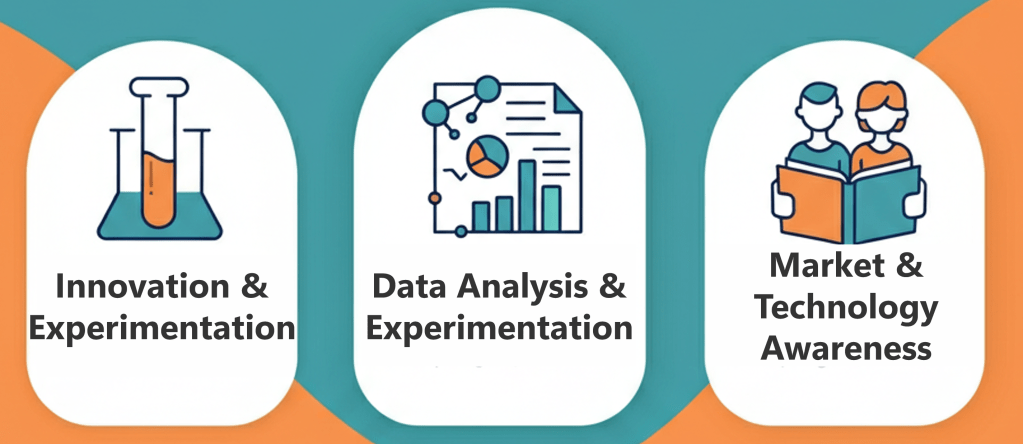
Innovation & Experimentation: Using data-driven approaches to validate ideas

  • Design Thinking & User-Centred Design: Applying design thinking ensures products are developed with a deep understanding of user needs.
  • Lean Startup & Agile Methodologies: Adopting lean startup and agile methodologies enables product managers to quickly test and validate ideas.
  • Data Analysis & Experimentation: Product managers should use data to optimise product performance (e.g., A/B testing landing pages). Continuous improvement relies on feedback loops and iterative development. Product managers should actively solicit customer feedback, analyse usage data, and conduct experiments to test and refine their products. For example, Amazon famously uses A/B testing to optimise its website and product pages, constantly experimenting with different layouts, messaging, and calls to action to improve conversion rates.

Market & Technology Awareness: Staying ahead of market trends

  • Emerging Technologies & Industry Trends: Staying informed about emerging technologies allows product managers to identify new opportunities and anticipate disruptions.
  • Competitive Monitoring & Benchmarking: Product managers should conduct competitive monitoring and benchmarking to gain insights into product strategy.
  • Continuous Learning & Knowledge Sharing: A commitment to continuous learning ensures product managers stay up-to-date with best practices.

4 – Measuring ROI: Demonstrating the Value of Product Management

Measuring product management activities’ return on investment (ROI) is crucial for demonstrating its value and securing continued support for these initiatives. However, as a Harvard Business Review study highlights, many executives lack confidence in accurately assessing product development ROI. This lack of confidence underscores the need for robust product management practices that track key metrics and demonstrate tangible impact. (HBR Analytic Services, 2019)
To effectively measure the ROI of your product management efforts, consider tracking these key areas:

Product-Specific Metrics:

  • Product Success Rate: The percentage of launched products that meet pre-defined success criteria (e.g., achieving target revenue, user adoption, or market share).
  • Time to Market: The time it takes to bring a product from ideation to launch, reflecting the efficiency of the product development process.
  • Customer Satisfaction: Measured through metrics like Net Promoter Score (NPS), Customer Satisfaction Score (CSAT), and customer reviews, indicating how well the product meets customer needs.
  • Feature Adoption Rate: The percentage of users adopting and actively using specific features, highlighting the value and effectiveness of product enhancements.
  • Revenue and Profitability: Track the direct revenue generated by the product, as well as its contribution margin and profitability.

Team-Related Metrics:

  • Team Performance: Assess the product team’s effectiveness through metrics like sprint velocity (in Agile development), on-time delivery, and achievement of sprint goals.
  • Employee Satisfaction and Retention: Measure employee engagement, satisfaction, and retention within the product team, reflecting the impact of leadership and development initiatives.

Customer-Focused Metrics:

  • Customer Acquisition Cost (CAC): The cost of acquiring a new customer that can be reduced through effective product-led growth strategies.
  • Customer Lifetime Value (CLTV): The predicted net profit attributed to a customer’s future relationship that can be increased through product enhancements and customer retention efforts.
  • Churn Rate: The rate at which customers stop using the product, indicating areas for improvement in product value or customer engagement.

By consistently tracking and analysing these metrics, product managers can demonstrate the tangible impact of their work, justify investment in product management capabilities, and drive continuous improvement within their organisations.

Elevate your product team and maximise your product development ROI. Contact me to discuss a customised training program.

Bibliography

Aulet, B. (2013). Disciplined Entrepreneurship: 24 Steps to a Successful Startup. HBR Press.

Gil, Elad. High Growth Handbook. Accessed via Stripe Atlas https://www.forbes.com/sites/quora/2012/12/10/does-stripe-have-product-managers-or-do-engineers-manage-the-products-themselves/

HBR Analytic Services. (2019). Closing the Data Gap in Product Development. Harvard Business Review.

Categories
Agile success principles Change Management Delivery

Exploring the Benefits of a Product-Focused vs. Agile Team Approach: A Shift in Perspective

“The typical organization today has undertaken five major firmwide changes in the past three years — and nearly 75% expect to multiply the types of major change initiatives they will undertake in the next three years. Yet half of change initiatives fail, and only 34% are a clear success.”  Gartner.com

Key Differences

Benefits of Product-Focused Organisations

Product-focused organisations offer several advantages over traditional agile structures, including customer-centricity, cross-functional teams, prioritisation and focus, reduced handoffs, and empowered product ownership. These benefits significantly improve efficiency, product quality, and market responsiveness.

For instance, Schneider Electric successfully transitioned to a product-driven operating model at scale. This shift enabled them to increase the speed of their product delivery from five years to just 18 months and boosted employee engagement by eight percentage points. This example illustrates how adopting a product-focused approach can lead to faster development cycles, improved employee satisfaction, and better alignment with customer needs. Lessons from Schneider Electric’s Agile-at-Scale Transformation | BCG

Increased Customer-Centricity

Product development revolves around thoroughly understanding customer needs and desires. This ensures that the final product truly resonates with the target audience and effectively addresses their pain points.

Enhanced Cross-Functional Collaboration

Teams are composed of individuals with diverse skill sets, including design, engineering, marketing, and product management. This collaborative environment fosters a holistic understanding of the product and its lifecycle.

Improved Prioritisation and Focus

Clear product roadmaps are established, enabling teams to prioritise tasks effectively and maintain alignment with the overall product vision. This reduces wasted effort and ensures everyone is working towards a common goal.

Reduced Handoffs

Streamlined workflows minimise dependencies between different teams, leading to faster development cycles and reduced communication overhead. This efficiency gain contributes to quicker time-to-market and improved product quality.

Empowered Product Ownership

Dedicated product owners have greater autonomy and decision-making power. This allows them to be more responsive to customer feedback and market changes, leading to more successful products.

Enterprise Benefits

  • Reduced Costs: Streamlined workflows, reduced handoffs, and clear prioritisation minimise wasted effort and resources, leading to significant long-term cost savings.
  • Increased Revenue: Customer-centric products are more likely to succeed in the market, attracting and retaining customers and ultimately driving revenue growth.
  • Reduced Risk: A deep understanding of customer needs and market trends reduces the likelihood of developing products that fail to resonate with target audiences, minimising financial losses and reputational damage.

Employee Empowerment and Growth

  • Increased Employee Satisfaction: Employees feel a stronger sense of ownership and purpose when working within a product-focused organisation. They are more engaged in their work and feel their contributions directly impact the product’s success.
  • Improved Retention: A fulfilling work environment that provides opportunities for growth and development fosters employee loyalty and reduces turnover. This saves the company time and resources for recruiting and training new employees.
  • Clearer Career Paths: A product-focused structure provides employees with clear career trajectories and development opportunities, motivating them to contribute their best work and grow within the organisation.

Organisational Alignment: Defining Your Identity, Offerings, and Structure

In the journey towards adopting a product-focused approach, organisations must achieve clarity on three fundamental aspects: who they are, what they offer, and how they want to be organised. This alignment ensures that every team member works towards a common goal and that the organisation’s structure supports its strategic objectives.

Defining Your Identity

Understanding and articulating your organisation’s identity is the first step. This involves recognising your core values, mission, and vision. These elements serve as the foundation for all decisions and help create a cohesive culture. When everyone in the organisation understands and embraces these core principles, it fosters a sense of unity and purpose.

Clarifying Your Offerings

Next, it’s essential to understand what your organisation offers clearly. This means identifying your essential products or services and understanding how they meet your customers’ needs. By having a well-defined product vision, teams can align their efforts towards creating value for the customer. This clarity helps prioritise tasks and make informed decisions that drive the organisation forward.

Structuring for Success

Finally, determining how you want to be organised is critical for operational efficiency. A product-focused structure often involves cross-functional teams aligned with specific products or services. This setup encourages collaboration and reduces silos, enabling teams to work more effectively towards common goals. Empowering product owners with decision-making authority ensures that the organisation can respond swiftly to market changes and customer feedback.

The Benefits of Alignment

When an organisation is aligned on its identity, offerings, and structure, it reaps several benefits:

  • Enhanced Collaboration: Teams work together more effectively, breaking down silos and fostering a culture of cooperation.
  • Improved Focus: Clear priorities and a shared vision ensure everyone works towards the same objectives, reducing wasted effort.
  • Greater Agility: An aligned organisation can respond more quickly to market or customer needs changes, maintaining a competitive edge.
  • Increased Employee Engagement: Employees who understand the organisation’s mission and see how their work contributes to its success are more motivated and engaged.

Conclusion

Product-focused organisations offer a compelling alternative to traditional agile structures. They promote customer-centricity, streamlined workflows, and empowered product ownership. While agile methodologies remain valuable, adopting a product focus can further enhance organisational effectiveness, product success, and employee satisfaction.

If your organisation wants to improve its alignment with customer needs, increase efficiency, and empower your teams, consider transitioning to a product-focused approach. Start by defining your identity, clarifying your offerings, and structuring your teams for success. Doing so can create a strong foundation for sustainable growth and innovation.

Categories
Agile success principles Change Management Leadership

Driving Innovation Through Effective Leadership

In today’s fast-paced and ever-evolving business landscape, innovation and creativity are more critical than ever for maintaining a competitive edge. However, achieving these goals requires more than just a spark of genius; it demands a strategic alignment of leadership, structure, and continuous improvement. This article will delve into how effective leadership can foster innovation, the importance of balancing structure with flexibility, and the role of continuous improvement in driving sustained success. By understanding and implementing these fundamental principles, organisations can create an environment where innovation thrives and creativity flourishes.

The Role of Leadership in Fostering Innovation

The rapidly evolving business landscape requires innovation, which is the key to staying ahead of the competition. Effective leadership plays a pivotal role in fostering an environment where innovation can thrive. Here are three essential ways leaders can drive innovation within their organisations.

  1. Creating a Culture of Trust and Collaboration – Trust and collaboration are the cornerstones of an innovative culture. Leaders must create an environment where employees feel safe sharing their ideas and taking risks. This involves open communication, encouraging teamwork, and recognising the contributions of all team members. When employees trust their leaders and colleagues, they are more likely to collaborate and develop creative solutions to problems.
  2. Providing Resources and Support for Professional Development – Investing in employees’ professional development is another critical aspect of fostering innovation. Leaders should provide resources for continuous learning, such as training programs, workshops, and access to industry conferences. By supporting their team’s growth, leaders can ensure that employees stay up-to-date with the latest trends and technologies, which can lead to innovative ideas and solutions.
  3. Leading by Example and Encouraging Experimentation – Leaders willing to experiment and embrace new ideas set a powerful example for their teams. By leading by example and showing that they are open to change and innovation, leaders can inspire their teams to do the same. Encouraging experimentation and allowing failure as a learning opportunity can lead to breakthrough innovations and continuous improvement.

Balancing Structure and Flexibility

While structure provides a solid foundation for an organisation, flexibility is essential for adapting to new opportunities and challenges. Striking the right balance between structure and flexibility can drive innovation and creativity.

  • Creating a Dynamic Learning Environment – A dynamic learning environment encourages employees to learn and grow continuously and requires providing opportunities for skill development and creating a culture where learning is valued. By balancing structure with flexibility, organisations can create an environment that promotes creativity, critical thinking, and engagement.
  • Adapting to Changing Needs – In today’s fast-paced world, organisations must be able to adapt to changing needs. This requires a balance between a structured approach to strategy and being flexible enough to pivot when necessary. By maintaining a solid framework of policies and processes while also being agile, organisations can innovate and respond to new opportunities and challenges.
  • Enhancing Team Collaboration – Effective teamwork often requires a balance between structure and flexibility. A well-defined structure provides a framework for team members to collaborate efficiently, ensuring everyone understands their roles and responsibilities. At the same time, flexibility allows team members to bring their unique perspectives and ideas to the table, fostering innovation and creativity.

Measuring Success and Continuous Improvement

Organisations must continuously measure their progress and adjust as needed to ensure the success of innovation efforts. This involves utilising key performance indicators (KPIs), implementing the Plan-Do-Check-Act (PDCA) cycle, and nurturing a culture of continuous improvement.

  • Utilising Key Performance Indicators (KPIs) – KPIs are essential for tracking the effectiveness of continuous improvement initiatives. They provide quantifiable metrics that offer insights into process efficiency, effectiveness, and overall success. By selecting the right KPIs, organisations can monitor progress, identify areas for improvement, and make data-driven decisions.
  • Implementing the PDCA Cycle – The Plan-Do-Check-Act (PDCA) cycle is a widely used methodology for continuous improvement. It involves planning changes, implementing them on a small scale, checking the results, and acting based on the findings. This iterative process helps organisations continuously refine their strategies and achieve better results. By following the PDCA cycle, organisations can systematically identify areas for improvement, test potential solutions, and implement the most effective changes, thereby driving continuous improvement and innovation.
  • Nurturing a Culture of Continuous Improvement – Success in continuous improvement requires a culture that values ongoing learning and adaptation. Organisations should encourage employees to identify opportunities for improvement, experiment with new ideas, and share their findings. This culture of continuous improvement helps organisations stay agile and responsive to changing needs.

In conclusion, establishing and embedding innovation within an organisation requires effective leadership, a balance between structure and flexibility, and a commitment to continuous improvement. By creating a culture of trust and collaboration, providing resources for professional development, and leading by example, leaders can inspire their teams to innovate. Balancing structure with flexibility allows organisations to adapt to changing needs and enhance team collaboration. Finally, measuring success and nurturing a culture of continuous improvement ensures that innovation efforts are sustained and effective. Organisations can drive innovation and creativity by focusing on these critical areas, leading to long-term success.

Categories
Agile success principles Delivery Leadership Portfolio Management

Maximizing Delivery Success: The Power of Visibility, Proactive Dependency Management, and Strategic Roadmap Planning

In the fast-paced realm of program delivery, navigating interdependencies, anticipating upcoming challenges, and maintaining transparency across all levels of an organisation is crucial. This article explores the essential elements of effective delivery portfolio management: visibility, active dependency management, and a comprehensive upcoming roadmap, highlighting their significance in achieving success in delivering strategic outcomes.

Visibility: The Foundation of Trust and Alignment

Visibility in program and project management extends beyond tracking tasks. It involves providing clarity and transparency of program status, progress, and challenges to ensure every team member, stakeholder, and leader can access real-time information. This transparency is pivotal in nurturing trust, enabling informed decision-making, and aligning efforts towards strategic objectives. Tips to enhance visibility include:

  1. Implement Visual Management Systems: Utilise tools and platforms that offer real-time visibility into project statuses, progress, and challenges. For example, creating dashboards displaying key performance indicators (KPIs) and project milestones can assist stakeholders in staying informed and making data-driven decisions. These tools include Jira (Atlassian) and Azure DevOps (Microsoft). They are lightweight, cost-effective, and easy to scale across teams.
  2. Regular Planning Sessions and Stand-ups: Embrace agile practices such as fortnightly planning sessions and daily stand-ups to increase team transparency and alignment. This approach enables teams to align priorities and manage workloads effectively, creating a culture of openness and continuous improvement.
  3. Regular Planning Sessions and Stand-ups: Embrace working practices such as fortnightly planning sessions and daily stand-ups to increase team transparency and alignment. This approach enables teams to align priorities and manage workloads effectively. When incorporated with other practices that showcase work to obtain feedback and reflection to drive continuous improvement, teams go from being busy to delivering the right value.
  4. Mission Control Spaces: Establish dedicated visual management boards where project information is consolidated and centrally accessible. These boards provide easily understood information on progress, risks, and dependencies. Such physical or virtual boards create a single source of truth for always on project status, facilitating better decision-making and problem-solving. Examples of effective tools are Jira Align (Atlassian) and Miro.

Active Dependency Management: Navigating the Web of Interdependencies

Active dependency management involves proactively identifying, tracking, and resolving dependencies between tasks, teams, and resources to prevent bottlenecks and delays. The challenge lies in systematically identifying and resolving these interdependencies, necessitating a proactive stance to anticipate potential issues and devise mitigation strategies. Understanding each role and responsibility is crucial for effective dependency management to ensure unforeseen interdependencies do not derail projects.

  1. Map and Monitor Dependencies: Develop a systematic approach to identifying and tracking dependencies across projects. Tools like Jira Align can help visualise and manage dependencies to address potential bottlenecks proactively.
  2. Cross-Functional Collaboration: Nurture a culture of collaboration across different teams and departments. Encourage regular cross-functional meetings to discuss dependencies, share insights, and develop joint risk mitigation strategies. Approaches can also include co-creating solutions and leveraging shared resources to overcome challenges.
  3. Build an organisation around the flow of work: Organise teams into agile Tribes (programs) and Squads (teams) aligned around common objectives while minimising dependencies. This structure promotes autonomy and faster decision-making and reduces the complexity of managing interdependencies.

Upcoming Roadmap: Charting the Course Forward

An upcoming roadmap is not just a document outlining future directions; it’s a strategic tool that guides teams, clarifying priorities and expectations. It ensures that all efforts are aligned with strategic goals, facilitating a unified approach to achieving them. The roadmap serves as a beacon, guiding teams through the complexities of project delivery and ensuring that every step contributes towards the overarching objectives. Aligning the business roadmap with customer journeys and strategic initiatives is crucial for delivering value and securing a competitive advantage.

  1. Co-create roadmaps: Engage key stakeholders in the roadmap creation process to ensure strategic goals and priorities are aligned. This collaborative approach ensures that the roadmap reflects the organisation’s collective vision and objectives, enhancing buy-in and commitment.
  2. Quarterly Business Reviews (QBRs): Conduct QBR planning sessions to review progress against the roadmap, adjust priorities based on new insights, and set clear objectives for the upcoming quarter. This iterative process allows flexibility in responding to changes and ensures the roadmap remains relevant and aligned with strategic goals.
  3. OKRs and Performance Metrics: Implement Objectives and Key Results (OKRs) to link strategic goals with specific, measurable outcomes. This goal-setting framework helps track progress against the roadmap, ensuring efforts focus on achieving high-impact results.

In summary…

Visibility, active dependency management, and a well-defined forward-looking roadmap are crucial for successfully managing a delivery portfolio. These elements enhance operational efficiency and develop a culture of transparency, collaboration, and strategic alignment. By prioritising these aspects, organisations can navigate the complexities of project delivery with greater agility and predictability, ultimately driving better outcomes and value.

Categories
Agile success principles

Agile works when aligned to Good Management principles

There are many articles which point out instances of successful and failed Agile implementations. This Forbes article points out that the focus of creation of value for the customer is a key differentiator in Agile.

Agile Is Not Just Another Management Fad