

What separates companies with thriving product lines from those struggling to stay afloat? It’s not just luck. Forrester’s 2024 US Customer Experience Index research shows that prioritising customer experience, powered by strong product management, can unlock 4-8% higher revenue growth. However, without this focus, companies risk falling behind, missing crucial market opportunities, and wasting valuable resources on products that fail to resonate with customers. This article explores why investing in product management capabilities is crucial in today’s complex product landscape, where seamless collaboration, data-driven decisions, and adaptability are essential for success. We’ll delve into three key justifications for prioritising product management upskilling: optimising product outcomes, enhancing team effectiveness, and driving continuous improvement.
Upskilling is crucial for all product managers, though the focus varies by seniority. Early-career PMs benefit from training in user research and execution, while senior leaders need development in strategy and team leadership.
1 – Optimise Product Outcomes

It is imperative to build products that resonate with the market to achieve the desired market impact and business goals. These products must deliver demonstrable value to customers and contribute directly to strategic business goals. Product managers must have the skills to understand the needs and desires of their customers and what their competitors are doing to successfully provide solutions that are sufficiently differentiated and valuable to pique user interest.
Spotify Example: Spotify uses A/B testing to optimise the user experience, such as testing different playlist recommendation algorithms to maximise user engagement.
Market & User Understanding: Deepening knowledge of markets, users, and competitors
- Market Research & Analysis: Use techniques like TAM/SAM/SOM analysis to size your market accurately. For example, a product manager launching a project management tool could combine bottom-up analysis with Gartner data to ensure a realistic understanding of market potential.
- User Research: Employ both qualitative methods, such as user interviews and contextual inquiry, and quantitative methods, such as surveys and A/B testing. Conduct user interviews to uncover unmet needs, then validate findings with larger-scale surveys to ensure user-centred development. To truly understand customer needs, Christensen et al. (2016) emphasise the importance of going beyond traditional demographics and analysing the “jobs” customers are “hiring” products to do. This “Jobs to Be Done” framework focuses on understanding the underlying motivations and desired outcomes that drive customer behaviour. For example, a customer might “hire” a smartphone for communication, entertainment, social connection, and self-expression. By understanding these “jobs,” product managers can develop features and messaging that genuinely resonate with customer needs.
- Competitive Analysis: Analyse competitors’ strengths, weaknesses, and strategies to inform strategic decisions about pricing, features, and target markets, leading to stronger market positioning. Product managers must also be adept at competitive analysis, identifying both direct and indirect competitors. By analysing competitors’ strengths, weaknesses, and strategies, they can identify opportunities for differentiation and develop unique selling propositions that resonate with target customers. Opportunities include offering unique features, superior performance, a more compelling brand story, or a more competitive pricing strategy.
“The most important thing is to get out of the building and talk to customers.” (Aulet, 2013)
Product Definition & Strategy: Defining winning strategies and actionable plans
- Product Vision & Strategy: Define a clear and compelling product vision to align the team with business strategy and maximise long-term product success. For example, Tesla’s vision for sustainable energy permeates every aspect of its product strategy. This vision is evident in their relentless focus on improving battery technology, developing a comprehensive charging infrastructure, and offering over-the-air software updates that continuously enhance vehicle performance and features.
- Product Roadmapping & Prioritisation: Use prioritisation frameworks like MoSCoW or RICE (Reach, Impact, Confidence, Effort) to ensure development focuses on high-value features, directly impacting ROI. RICE scoring allows objective feature comparison.
- Product Requirements & Specifications: Precise documentation minimises ambiguity and rework.
Go-to-Market Execution: Improving product launches and market engagement
- Go-to-Market Strategy: A well-defined go-to-market strategy ensures coordinated launches for maximum market penetration. Amazon often uses beta testing and phased rollouts.
- Product Marketing & Messaging: Compelling messaging drives product adoption. However, even with strong messaging, poor execution can hinder success. A study by Repsly found that nearly 55% of promotions fail to impact sales due to poor execution. This failure highlights the importance of the product manager’s role in ensuring seamless go-to-market execution. (Repsly, n.d.)
- Launch Execution & Performance Tracking: Product managers should track key performance indicators (KPIs) throughout the launch process to measure success and identify areas for improvement. These KPIs might include conversion rates (e.g., website visits to sign-ups), customer acquisition cost (CAC), user engagement metrics (e.g., daily active users, time spent on the app), and customer satisfaction scores (e.g., Net Promoter Score).
2 – Enhancing Team Effectiveness – Maximising Collaboration and Communication

Product Managers are crucial in building high-performing teams by facilitating effective collaboration and communication across all functions.
Stripe, an emerging global payment service provider, sees Product Management capability as essential in creating the alignment to deliver at pace.
“Have you been able to sell a vision or product to your last company’s leadership team? What disagreements or conflicts did the PM have with engineering or design? How were these disagreements resolved? How does the PM actively build relationships with other parts of the organisation?… There is a natural tension between product, design, and engineering. Conflicts may arise naturally in a fast-paced environment. The key is how to build relationships to surmount disagreements and how to resolve conflicts if they do occur.”(Gil, 2018)
Communication & Influence: Mastering communication for stakeholder influence
- Communication & Presentation Skills: Product managers must tailor their communication style to different audiences. When presenting to executives, they might focus on data-driven insights and ROI projections. When collaborating with engineers, they might delve into technical details and user stories. Emotional intelligence and empathy are also crucial for building strong relationships, understanding diverse perspectives, and navigating disagreements effectively.
- Stakeholder Management: Effective stakeholder management ensures stakeholder alignment and reduces conflicts.
- Negotiation & Conflict Resolution: Product managers should develop skills to navigate disagreements and maintain positive relationships.
Collaborative Leadership: Leading and motivating cross-functional teams
- Cross-Functional Team Leadership: Effective cross-functional team leadership empowers product managers to motivate teams and achieve product goals. Effective product managers empower their teams by delegating responsibilities, providing autonomy, and recognising individual contributions. They foster a collaborative environment where open communication, constructive feedback, and shared decision-making are encouraged.
- Meeting Management & Collaboration Tools: Effective meeting management techniques and collaboration tools improve team efficiency and communication.
- Building Consensus & Alignment: Product managers should focus on ensuring a shared understanding of product goals.
Facilitation and Alignment: Driving shared understanding and agreement within the team
- Facilitation Techniques: Use techniques like workshops, brainstorming sessions, and structured discussions to guide team conversations and effectively drive towards shared outcomes.
- Cross-Functional Alignment: Proactively work to align different functional perspectives (e.g., engineering, marketing, sales) by clearly articulating the product vision, strategy, and roadmap.
- Conflict Management and Resolution: Develop skills to effectively mediate conflicts and disagreements within the team, fostering a positive and productive working environment.
3 – Driving Continuous Improvement – Driving Innovation and Adaptability
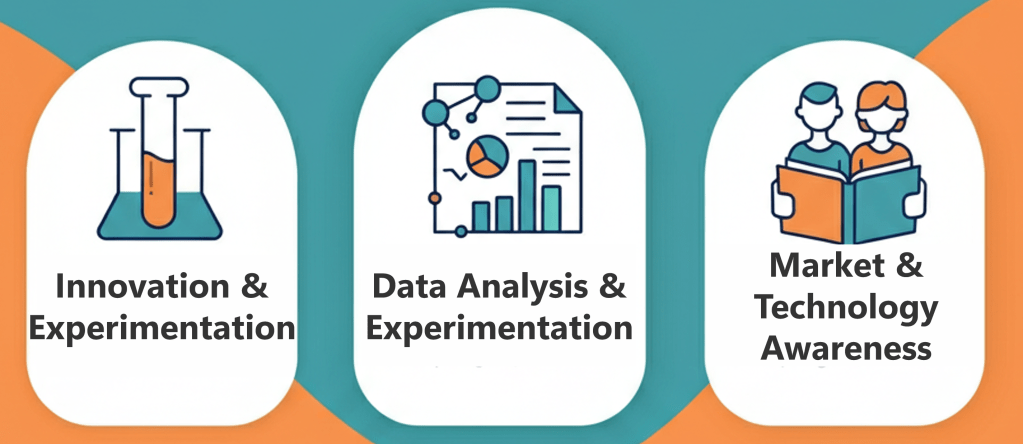
In today’s dynamic market, continuous improvement through innovation and adaptability is essential for sustained success.
Tesla Example: Tesla uses over-the-air updates to continuously improve its products, demonstrating a commitment to ongoing value delivery.
Innovation & Experimentation: Using data-driven approaches to validate ideas
- Design Thinking & User-Centred Design: Applying design thinking ensures products are developed with a deep understanding of user needs.
- Lean Startup & Agile Methodologies: Adopting lean startup and agile methodologies enables product managers to quickly test and validate ideas.
- Data Analysis & Experimentation: Product managers should use data to optimise product performance (e.g., A/B testing landing pages). Continuous improvement relies on feedback loops and iterative development. Product managers should actively solicit customer feedback, analyse usage data, and conduct experiments to test and refine their products. For example, Amazon famously uses A/B testing to optimise its website and product pages, constantly experimenting with different layouts, messaging, and calls to action to improve conversion rates.
Market & Technology Awareness: Staying ahead of market trends
- Emerging Technologies & Industry Trends: Staying informed about emerging technologies allows product managers to identify new opportunities and anticipate disruptions.
- Competitive Monitoring & Benchmarking: Product managers should conduct competitive monitoring and benchmarking to gain insights into product strategy.
- Continuous Learning & Knowledge Sharing: A commitment to continuous learning ensures product managers stay up-to-date with best practices.
4 – Measuring ROI: Demonstrating the Value of Product Management

Measuring product management activities’ return on investment (ROI) is crucial for demonstrating its value and securing continued support for these initiatives. However, as a Harvard Business Review study highlights, many executives lack confidence in accurately assessing product development ROI. This lack of confidence underscores the need for robust product management practices that track key metrics and demonstrate tangible impact. (HBR Analytic Services, 2019)
To effectively measure the ROI of your product management efforts, consider tracking these key areas:
Product-Specific Metrics:
- Product Success Rate: The percentage of launched products that meet pre-defined success criteria (e.g., achieving target revenue, user adoption, or market share).
- Time to Market: The time it takes to bring a product from ideation to launch, reflecting the efficiency of the product development process.
- Customer Satisfaction: Measured through metrics like Net Promoter Score (NPS), Customer Satisfaction Score (CSAT), and customer reviews, indicating how well the product meets customer needs.
- Feature Adoption Rate: The percentage of users adopting and actively using specific features, highlighting the value and effectiveness of product enhancements.
- Revenue and Profitability: Track the direct revenue generated by the product, as well as its contribution margin and profitability.
Team-Related Metrics:
- Team Performance: Assess the product team’s effectiveness through metrics like sprint velocity (in Agile development), on-time delivery, and achievement of sprint goals.
- Employee Satisfaction and Retention: Measure employee engagement, satisfaction, and retention within the product team, reflecting the impact of leadership and development initiatives.
Customer-Focused Metrics:
- Customer Acquisition Cost (CAC): The cost of acquiring a new customer that can be reduced through effective product-led growth strategies.
- Customer Lifetime Value (CLTV): The predicted net profit attributed to a customer’s future relationship that can be increased through product enhancements and customer retention efforts.
- Churn Rate: The rate at which customers stop using the product, indicating areas for improvement in product value or customer engagement.
By consistently tracking and analysing these metrics, product managers can demonstrate the tangible impact of their work, justify investment in product management capabilities, and drive continuous improvement within their organisations.
Elevate your product team and maximise your product development ROI. Contact me to discuss a customised training program.
Bibliography
Aulet, B. (2013). Disciplined Entrepreneurship: 24 Steps to a Successful Startup. HBR Press.
Gil, Elad. High Growth Handbook. Accessed via Stripe Atlas https://www.forbes.com/sites/quora/2012/12/10/does-stripe-have-product-managers-or-do-engineers-manage-the-products-themselves/
HBR Analytic Services. (2019). Closing the Data Gap in Product Development. Harvard Business Review.




 Its Just Good Management