
To successfully execute strategy at scale in today’s volatile market, an organisation must treat transformation as an integrated effort across three non-negotiable pillars: Culture, Process, and Tools. Failure to align any one pillar—what is known as the “Tool-Only Trap”—results in significant cost, resistance, and the ultimate strategic frustration: Good ideas die at scale.
The fundamental mistake is believing software alone delivers strategic alignment. True value, in the form of driving value and removing cost, is only unlocked when a deliberate methodology is applied to reshape organisational practices and mindsets.
To achieve this integrated success, the effort must be launched across the three pillars in deliberate sequence.
1 – Align Strategic Commitment and Mindset
The primary barrier to successful strategy execution is not technical; it is cultural. Alignment to what is most important requires a fundamental shift in mindset, driven by leadership commitment.
- Change the DNA: Without a fundamental shift in culture, technological upgrades will ultimately be met with resistance and inertia.
- Prioritise People: This means focusing on the fundamental ways your people interact and operate. Leadership must commit to communicating a clear strategic vision and the “why” behind every change. The focus must be on ensuring every team understands how their work contributes to the organisation’s core objectives.
- Mandate Enablement Tooling: Consistent tooling must be implemented as an enabler of this strategic commitment, not a dictator. Expertise is required to ensure the platform supports an empowered culture, preventing the organisation from simply forcing people into a rigid software configuration with no purpose.
However, a committed culture alone cannot deliver strategy at scale; it requires a defined system of work to connect vision to daily activity.

2 – The Critical Bridge: Defining Practices for Execution
Process architecture is the critical bridge that translates a strategic mindset into repeatable, efficient actions that the technology can support. This focuses on creating a robust System of Work for reliable strategy execution.
- Shared Language and Practices: The key outcome of adopting a structured approach is the creation of a shared organisational language and a common set of practices that are understood across all departments. This alignment is delivered by applying proven exercises designed to build consensus, clarify roles, and accelerate the adoption of new ways of working.
- Delivering Clarity and Focus: This cultural work delivers essential organisational structure and ensures the team is focused on what is most important by providing:
- Role Clarity and Alignment: Defined interaction models that clarify who is responsible for what, driving better communication and removing friction.
- Targeted Capability: Identification of capability gaps and specific coaching needs, ensuring people have the skills to execute the new strategy effectively.
- Process, Then Platform: The business must define how it wants to operate before the platform is configured, ensuring the practices are built into the tool, not dictated by it.
3 -Enabling Scale, Value, and Cost Reduction
Once the culture and process foundations are set, the integrated toolset becomes the powerful engine that delivers strategy at an enterprise level, directly contributing to business outcomes.
- From Reporting to Strategy: Strategic execution demands a single source of truth to prevent work from being siloed. This is the explicit function of the Atlassian Strategy Collection tools.
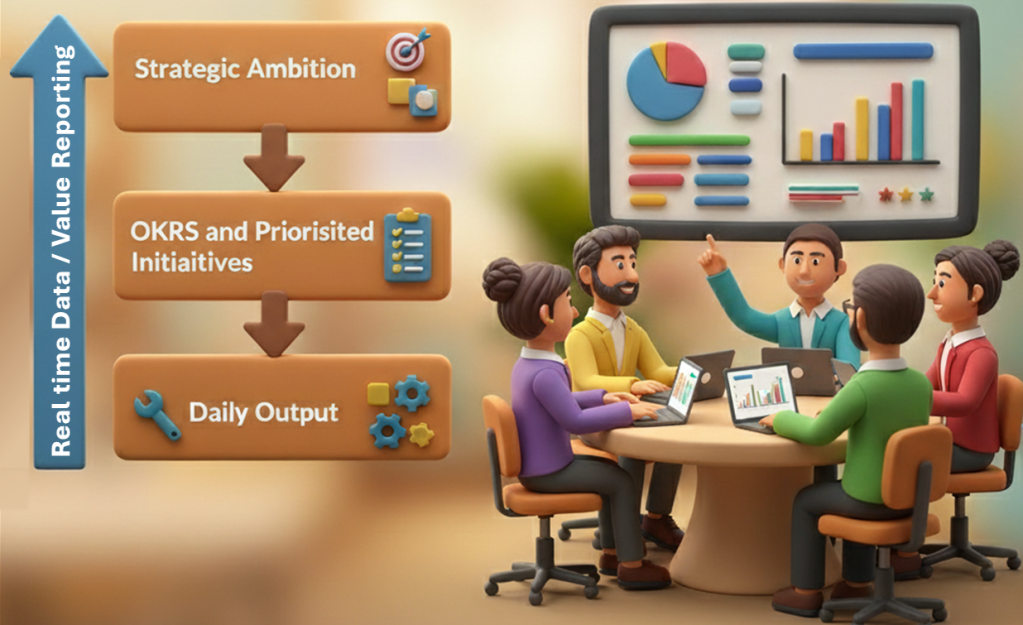
- Translating Vision to Work: Tools like Jira Align and Focus/Goals are engineered to provide a transparent and unbroken line from high-level strategic objectives (OKRs) down to the operational work of delivery teams. This is how the strategic ambition of the board is directly linked to the team’s daily output and ensures alignment to what is most important.
- Value and Cost Reduction: The platform enables real-time monitoring of Key Performance Indicators (KPIs), providing the immediate feedback necessary to make sound, data-informed decisions. This level of responsiveness reduces project churn, minimises wasted effort (cost reduction), and ensures resources are focused exclusively on initiatives that drive maximum business value.
The Need for Strategic Partnership
The ultimate value of any platform, whether it’s the Atlassian Stack or an existing bespoke system, is not unlocked through configuration; it is unlocked through comprehensive Transformation. This is a fundamental truth that holds whether your teams are using spreadsheets or a full suite of enterprise tools.
Partnering with a specialist ensures that the implementation leads with strategy, addresses cultural friction, and turns the technology investment into a genuine engine for sustained organisational success.
If your organisation is currently wrestling with the strategy-execution gap, or if your current tooling is generating friction instead of delivered value, a practical discussion is warranted.
Reach out to discuss your specific needs. Together we can design a pathway that actually gets your outcomes.


 Its Just Good Management