Categories
Dispersed Teams Portfolio Management

Beyond Jira: How Strategic Transformation (Culture, Not Configuration) Unlocks True Value in the Atlassian Stack

To successfully execute strategy at scale in today’s volatile market, an organisation must treat transformation as an integrated effort across three non-negotiable pillars: Culture, Process, and Tools. Failure to align any one pillar—what is known as the “Tool-Only Trap”—results in significant cost, resistance, and the ultimate strategic frustration: Good ideas die at scale.

The fundamental mistake is believing software alone delivers strategic alignment. True value, in the form of driving value and removing cost, is only unlocked when a deliberate methodology is applied to reshape organisational practices and mindsets.

To achieve this integrated success, the effort must be launched across the three pillars in deliberate sequence.

1 – Align Strategic Commitment and Mindset

The primary barrier to successful strategy execution is not technical; it is cultural. Alignment to what is most important requires a fundamental shift in mindset, driven by leadership commitment.

  • Change the DNA: Without a fundamental shift in culture, technological upgrades will ultimately be met with resistance and inertia.
  • Prioritise People: This means focusing on the fundamental ways your people interact and operate. Leadership must commit to communicating a clear strategic vision and the “why” behind every change. The focus must be on ensuring every team understands how their work contributes to the organisation’s core objectives.
  • Mandate Enablement Tooling: Consistent tooling must be implemented as an enabler of this strategic commitment, not a dictator. Expertise is required to ensure the platform supports an empowered culture, preventing the organisation from simply forcing people into a rigid software configuration with no purpose.

However, a committed culture alone cannot deliver strategy at scale; it requires a defined system of work to connect vision to daily activity.

2 – The Critical Bridge: Defining Practices for Execution

Process architecture is the critical bridge that translates a strategic mindset into repeatable, efficient actions that the technology can support. This focuses on creating a robust System of Work for reliable strategy execution.

  • Shared Language and Practices: The key outcome of adopting a structured approach is the creation of a shared organisational language and a common set of practices that are understood across all departments. This alignment is delivered by applying proven exercises designed to build consensus, clarify roles, and accelerate the adoption of new ways of working.
  • Delivering Clarity and Focus: This cultural work delivers essential organisational structure and ensures the team is focused on what is most important by providing:
  • Role Clarity and Alignment: Defined interaction models that clarify who is responsible for what, driving better communication and removing friction.
  • Targeted Capability: Identification of capability gaps and specific coaching needs, ensuring people have the skills to execute the new strategy effectively.
  • Process, Then Platform: The business must define how it wants to operate before the platform is configured, ensuring the practices are built into the tool, not dictated by it.

3 -Enabling Scale, Value, and Cost Reduction

Once the culture and process foundations are set, the integrated toolset becomes the powerful engine that delivers strategy at an enterprise level, directly contributing to business outcomes.

  • From Reporting to Strategy: Strategic execution demands a single source of truth to prevent work from being siloed. This is the explicit function of the Atlassian Strategy Collection tools.
  • Translating Vision to Work: Tools like Jira Align and Focus/Goals are engineered to provide a transparent and unbroken line from high-level strategic objectives (OKRs) down to the operational work of delivery teams. This is how the strategic ambition of the board is directly linked to the team’s daily output and ensures alignment to what is most important.
  • Value and Cost Reduction: The platform enables real-time monitoring of Key Performance Indicators (KPIs), providing the immediate feedback necessary to make sound, data-informed decisions. This level of responsiveness reduces project churn, minimises wasted effort (cost reduction), and ensures resources are focused exclusively on initiatives that drive maximum business value.
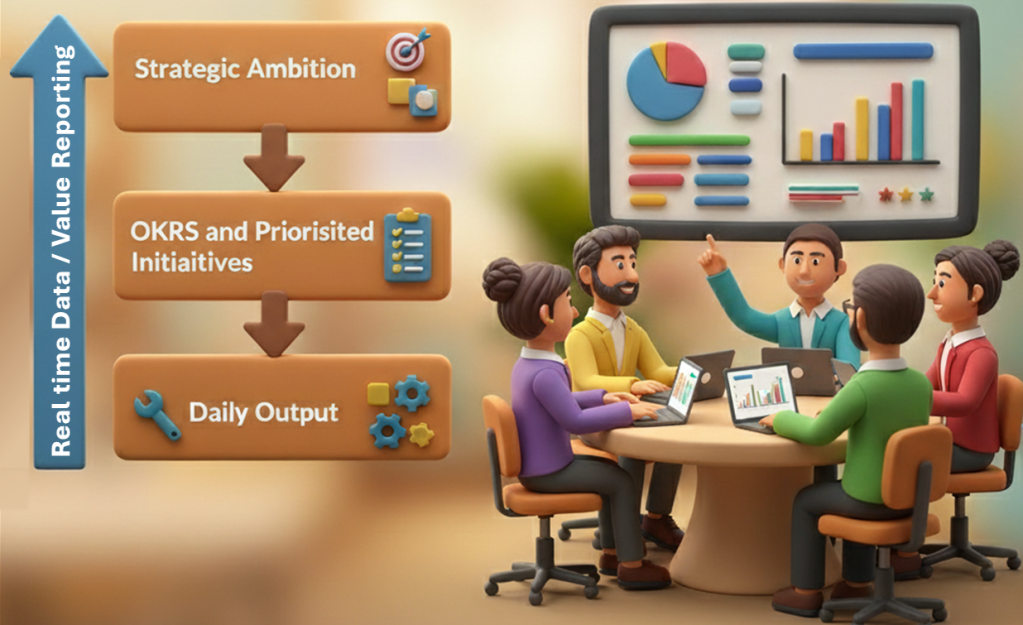
Visual representation of a team collaborating using data-driven strategies to enhance organizational performance.

The Need for Strategic Partnership

The ultimate value of any platform, whether it’s the Atlassian Stack or an existing bespoke system, is not unlocked through configuration; it is unlocked through comprehensive Transformation. This is a fundamental truth that holds whether your teams are using spreadsheets or a full suite of enterprise tools.

Partnering with a specialist ensures that the implementation leads with strategy, addresses cultural friction, and turns the technology investment into a genuine engine for sustained organisational success.

If your organisation is currently wrestling with the strategy-execution gap, or if your current tooling is generating friction instead of delivered value, a practical discussion is warranted.

Reach out to discuss your specific needs. Together we can design a pathway that actually gets your outcomes.

Categories
Delivery Leadership

Aligning Value, Teaming, and Objectives for Business Success

In today’s fast-paced business environment, aligning value, teaming, and objectives is crucial for success. This alignment ensures that every team member works towards a common goal, creating value for the organisation and its customers. Let’s explore how these three elements can be harmonised to drive success.

Value: The Core of Every Initiative

Understanding the “why” behind the work is fundamental to any successful business initiative. It starts with identifying the core purpose and the desired outcomes. This involves asking critical questions such as: What are we trying to achieve? Why is this important? How will it benefit our customers and the organisation?

Once the purpose is clear, defining success becomes the next step. Success should be tangible and measurable. For instance, it could be increased customer satisfaction, higher revenue, or improved operational efficiency. These success metrics need to be clearly articulated and communicated to the team.

Establishing a system for measuring and tracking progress ensures the team stays aligned with these goals. This could involve setting key performance indicators (KPIs) and regularly reviewing them to assess whether the team is on track. Tools like dashboards and progress reports can provide real-time insights into the team’s performance against the defined success metrics.

By understanding the reason behind the work, defining what success looks like, and establishing a robust system for measurement and tracking, teams can ensure that every effort is aligned with creating value for the organisation and its customers.

Teaming: Building a Cohesive Unit

Understanding the role the team plays in delivering the desired outcome is crucial for success. Each team member brings unique skills and perspectives that contribute to achieving the project’s goals. Recognising and leveraging these strengths is essential to create a cohesive unit that works seamlessly together.

To deliver the outcome, team members must understand how their contributions fit the bigger picture. This involves clear communication of roles and responsibilities and nurturing a collaborative environment where everyone feels empowered to share their ideas and feedback. Regular team meetings and retrospectives ensure everyone is aligned and working towards the same objectives.

Collaboration is key to success. Team members should be encouraged to work together, share knowledge, and support each other in overcoming challenges. This collaborative spirit helps build trust and ensures the team can adapt and respond effectively to changing circumstances.

“I once led a pilot team to prototype Agile ways of working within a traditional organisation. Our mission was clear: demonstrate that data solutions could be delivered faster, cheaper, and with greater customer engagement. The team was deeply committed to this purpose. We openly discussed how to collaborate effectively amongst ourselves and with other stakeholders. This pilot proved so successful that it sparked the creation of numerous other Agile teams across the organisation.”

This example illustrates how a shared purpose and open communication can empower a team to achieve remarkable results and drive organisational change.

Identifying the customer and understanding their needs is another critical aspect of effective teaming. The team should clearly understand who the customer is and what they expect from the project. This involves regular interactions with the customer to gather feedback and ensure that the team’s efforts are aligned with the customer’s requirements.

Additionally, the team needs to interact and integrate with other stakeholders and departments to deliver success. This could include working closely with marketing, IT, and customer service teams to ensure that all aspects of the project are covered and that there is a unified approach to achieving the project’s goals.

By understanding the team’s role, fostering collaboration, and maintaining clear communication with the customer and other stakeholders, teams can build a cohesive unit that is well-equipped to deliver successful outcomes.

Objectives: Setting Clear and Achievable Goals

Clear and achievable objectives are the foundation of any successful project. Objectives provide direction and a sense of purpose, helping teams stay focused and motivated. In Agile, objectives are often defined as user stories or epics, which outline the desired outcomes and the steps needed to achieve them.

When setting objectives, ensure they are specific, measurable, achievable, relevant, and time-bound (SMART). This approach helps teams understand what is expected of them and how their efforts contribute to the project’s overall success. Regularly review and adjust objectives to align with the organisation’s values and the team’s capabilities.

The Synergy of Value, Teaming, and Objectives

The true power of alignment lies in the synergy between value, teaming, and objectives. When these elements are harmonised, teams can work more efficiently and effectively, delivering high-quality results that drive success. Organisations can create a continuous improvement and innovation culture by focusing on value, building strong teams, and setting clear objectives.


In conclusion, aligning values, teaming, and objectives is essential for achieving success in today’s dynamic business environment. By prioritising value, fostering effective teaming, and setting clear objectives, organisations can ensure that every effort contributes to their overall goals. This alignment drives success and creates a positive and productive work environment where teams can thrive.

Categories
Agile success principles Change Management Leadership

Driving Innovation Through Effective Leadership

In today’s fast-paced and ever-evolving business landscape, innovation and creativity are more critical than ever for maintaining a competitive edge. However, achieving these goals requires more than just a spark of genius; it demands a strategic alignment of leadership, structure, and continuous improvement. This article will delve into how effective leadership can foster innovation, the importance of balancing structure with flexibility, and the role of continuous improvement in driving sustained success. By understanding and implementing these fundamental principles, organisations can create an environment where innovation thrives and creativity flourishes.

The Role of Leadership in Fostering Innovation

The rapidly evolving business landscape requires innovation, which is the key to staying ahead of the competition. Effective leadership plays a pivotal role in fostering an environment where innovation can thrive. Here are three essential ways leaders can drive innovation within their organisations.

  1. Creating a Culture of Trust and Collaboration – Trust and collaboration are the cornerstones of an innovative culture. Leaders must create an environment where employees feel safe sharing their ideas and taking risks. This involves open communication, encouraging teamwork, and recognising the contributions of all team members. When employees trust their leaders and colleagues, they are more likely to collaborate and develop creative solutions to problems.
  2. Providing Resources and Support for Professional Development – Investing in employees’ professional development is another critical aspect of fostering innovation. Leaders should provide resources for continuous learning, such as training programs, workshops, and access to industry conferences. By supporting their team’s growth, leaders can ensure that employees stay up-to-date with the latest trends and technologies, which can lead to innovative ideas and solutions.
  3. Leading by Example and Encouraging Experimentation – Leaders willing to experiment and embrace new ideas set a powerful example for their teams. By leading by example and showing that they are open to change and innovation, leaders can inspire their teams to do the same. Encouraging experimentation and allowing failure as a learning opportunity can lead to breakthrough innovations and continuous improvement.

Balancing Structure and Flexibility

While structure provides a solid foundation for an organisation, flexibility is essential for adapting to new opportunities and challenges. Striking the right balance between structure and flexibility can drive innovation and creativity.

  • Creating a Dynamic Learning Environment – A dynamic learning environment encourages employees to learn and grow continuously and requires providing opportunities for skill development and creating a culture where learning is valued. By balancing structure with flexibility, organisations can create an environment that promotes creativity, critical thinking, and engagement.
  • Adapting to Changing Needs – In today’s fast-paced world, organisations must be able to adapt to changing needs. This requires a balance between a structured approach to strategy and being flexible enough to pivot when necessary. By maintaining a solid framework of policies and processes while also being agile, organisations can innovate and respond to new opportunities and challenges.
  • Enhancing Team Collaboration – Effective teamwork often requires a balance between structure and flexibility. A well-defined structure provides a framework for team members to collaborate efficiently, ensuring everyone understands their roles and responsibilities. At the same time, flexibility allows team members to bring their unique perspectives and ideas to the table, fostering innovation and creativity.

Measuring Success and Continuous Improvement

Organisations must continuously measure their progress and adjust as needed to ensure the success of innovation efforts. This involves utilising key performance indicators (KPIs), implementing the Plan-Do-Check-Act (PDCA) cycle, and nurturing a culture of continuous improvement.

  • Utilising Key Performance Indicators (KPIs) – KPIs are essential for tracking the effectiveness of continuous improvement initiatives. They provide quantifiable metrics that offer insights into process efficiency, effectiveness, and overall success. By selecting the right KPIs, organisations can monitor progress, identify areas for improvement, and make data-driven decisions.
  • Implementing the PDCA Cycle – The Plan-Do-Check-Act (PDCA) cycle is a widely used methodology for continuous improvement. It involves planning changes, implementing them on a small scale, checking the results, and acting based on the findings. This iterative process helps organisations continuously refine their strategies and achieve better results. By following the PDCA cycle, organisations can systematically identify areas for improvement, test potential solutions, and implement the most effective changes, thereby driving continuous improvement and innovation.
  • Nurturing a Culture of Continuous Improvement – Success in continuous improvement requires a culture that values ongoing learning and adaptation. Organisations should encourage employees to identify opportunities for improvement, experiment with new ideas, and share their findings. This culture of continuous improvement helps organisations stay agile and responsive to changing needs.

In conclusion, establishing and embedding innovation within an organisation requires effective leadership, a balance between structure and flexibility, and a commitment to continuous improvement. By creating a culture of trust and collaboration, providing resources for professional development, and leading by example, leaders can inspire their teams to innovate. Balancing structure with flexibility allows organisations to adapt to changing needs and enhance team collaboration. Finally, measuring success and nurturing a culture of continuous improvement ensures that innovation efforts are sustained and effective. Organisations can drive innovation and creativity by focusing on these critical areas, leading to long-term success.