Categories
Dispersed Teams Portfolio Management

Beyond Jira: How Strategic Transformation (Culture, Not Configuration) Unlocks True Value in the Atlassian Stack

To successfully execute strategy at scale in today’s volatile market, an organisation must treat transformation as an integrated effort across three non-negotiable pillars: Culture, Process, and Tools. Failure to align any one pillar—what is known as the “Tool-Only Trap”—results in significant cost, resistance, and the ultimate strategic frustration: Good ideas die at scale.

The fundamental mistake is believing software alone delivers strategic alignment. True value, in the form of driving value and removing cost, is only unlocked when a deliberate methodology is applied to reshape organisational practices and mindsets.

To achieve this integrated success, the effort must be launched across the three pillars in deliberate sequence.

1 – Align Strategic Commitment and Mindset

The primary barrier to successful strategy execution is not technical; it is cultural. Alignment to what is most important requires a fundamental shift in mindset, driven by leadership commitment.

  • Change the DNA: Without a fundamental shift in culture, technological upgrades will ultimately be met with resistance and inertia.
  • Prioritise People: This means focusing on the fundamental ways your people interact and operate. Leadership must commit to communicating a clear strategic vision and the “why” behind every change. The focus must be on ensuring every team understands how their work contributes to the organisation’s core objectives.
  • Mandate Enablement Tooling: Consistent tooling must be implemented as an enabler of this strategic commitment, not a dictator. Expertise is required to ensure the platform supports an empowered culture, preventing the organisation from simply forcing people into a rigid software configuration with no purpose.

However, a committed culture alone cannot deliver strategy at scale; it requires a defined system of work to connect vision to daily activity.

2 – The Critical Bridge: Defining Practices for Execution

Process architecture is the critical bridge that translates a strategic mindset into repeatable, efficient actions that the technology can support. This focuses on creating a robust System of Work for reliable strategy execution.

  • Shared Language and Practices: The key outcome of adopting a structured approach is the creation of a shared organisational language and a common set of practices that are understood across all departments. This alignment is delivered by applying proven exercises designed to build consensus, clarify roles, and accelerate the adoption of new ways of working.
  • Delivering Clarity and Focus: This cultural work delivers essential organisational structure and ensures the team is focused on what is most important by providing:
  • Role Clarity and Alignment: Defined interaction models that clarify who is responsible for what, driving better communication and removing friction.
  • Targeted Capability: Identification of capability gaps and specific coaching needs, ensuring people have the skills to execute the new strategy effectively.
  • Process, Then Platform: The business must define how it wants to operate before the platform is configured, ensuring the practices are built into the tool, not dictated by it.

3 -Enabling Scale, Value, and Cost Reduction

Once the culture and process foundations are set, the integrated toolset becomes the powerful engine that delivers strategy at an enterprise level, directly contributing to business outcomes.

  • From Reporting to Strategy: Strategic execution demands a single source of truth to prevent work from being siloed. This is the explicit function of the Atlassian Strategy Collection tools.
  • Translating Vision to Work: Tools like Jira Align and Focus/Goals are engineered to provide a transparent and unbroken line from high-level strategic objectives (OKRs) down to the operational work of delivery teams. This is how the strategic ambition of the board is directly linked to the team’s daily output and ensures alignment to what is most important.
  • Value and Cost Reduction: The platform enables real-time monitoring of Key Performance Indicators (KPIs), providing the immediate feedback necessary to make sound, data-informed decisions. This level of responsiveness reduces project churn, minimises wasted effort (cost reduction), and ensures resources are focused exclusively on initiatives that drive maximum business value.
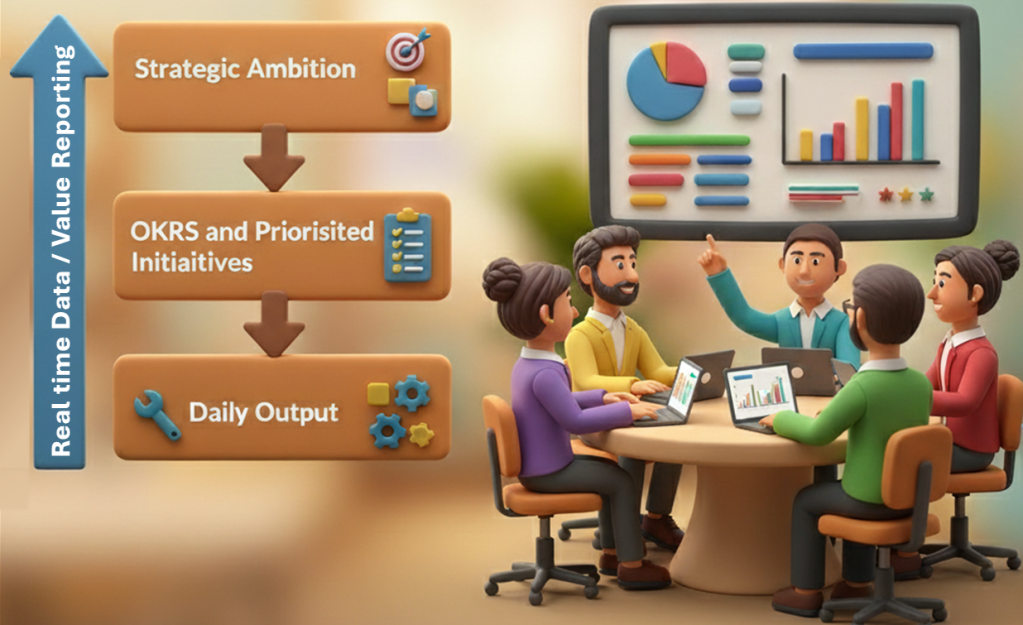
Visual representation of a team collaborating using data-driven strategies to enhance organizational performance.

The Need for Strategic Partnership

The ultimate value of any platform, whether it’s the Atlassian Stack or an existing bespoke system, is not unlocked through configuration; it is unlocked through comprehensive Transformation. This is a fundamental truth that holds whether your teams are using spreadsheets or a full suite of enterprise tools.

Partnering with a specialist ensures that the implementation leads with strategy, addresses cultural friction, and turns the technology investment into a genuine engine for sustained organisational success.

If your organisation is currently wrestling with the strategy-execution gap, or if your current tooling is generating friction instead of delivered value, a practical discussion is warranted.

Reach out to discuss your specific needs. Together we can design a pathway that actually gets your outcomes.

Categories
Change Management Delivery Leadership Portfolio Management

Are you Sabotaging Your ROI? Why You Need to Sweat the Small Stuff like Role Titles

Operating model design: sounds fancy, right? People often get caught up in process flows, org charts, and the nitty gritty. But are we missing the forest for the trees? I’m talking about something seemingly small but packing a surprisingly big punch: role titles. Think they’re just labels? Think again. In today’s brutal ROI environment, your role titles either drive your success or quietly kill it.

McKinsey highlights that improved communication and collaboration through social technologies could boost the productivity of interaction workers by 20-25%*

The critical point often missed is that technology alone isn’t the magic bullet. To realise those communication benefits and make that productivity jump, your organisation must make it easy to connect with the right people – the ones who can actually solve problems and drive value. And that’s where clear role titles become indispensable. Without them, even the best social technologies amplify the noise and confusion, increasing the speed and scale of non-productive and distracting communication.

Let’s be blunt. Even simple tasks can get derailed when you can’t figure out who to talk to in other parts of the company. Things get stuck, and time is wasted on basic stuff. Part of the problem? Fuzzy role titles. It’s not just about who’s in charge of projects; it’s about knowing who’s responsible and contactable across all parts of the company, even for everyday needs. The bottom line? Role titles matter if you want to get things done effectively across your organisation. Here’s why:

1. Titles Set the Tone: It’s All About Value (and ROI)

“What’s in a name?” Shakespeare might have been onto something but in business? Everything. Your role titles scream what you value as an organisation and, just as importantly, what you bring to the table. Forget fluffy language. We need titles that communicate value, impact, and ROI contribution, plain and simple.

  • Value = ROI. Titles Need to Show It: Remember “Scrum Master”? Nice for driving process, but today, the needs are broader and expectations higher! Try “Delivery Lead,’ or even “Delivery Coach” – titles that shout, “I deliver value!” If you want a different flavour, try “Delivery Coach” or “Value Coach”. It’s about outcomes, not just ceremonies. It’s about ROI, not just running meetings. Your titles should be value declarations. The HBR article, “How to Ask for the Job Title You Deserve,” says your title is your value pitch. Your role title tells your colleagues how you add value and why they should work with you.
  • Scope, Authority, Impact – Titles Define Your Turf: “Delivery Lead” isn’t just a fancy Scrum Master. It says, “I own value delivery.” Clarity = empowerment. You know your impact and focus on what matters: driving ROI. No more guessing games about who’s responsible for what. Titles don’t replace RACI; they amplify it. They make responsibilities stick and impact resonate, day in and day out. Titles should define your impact zone.
  • Perception is Reality. Titles Drive Performance: Titles shape how individuals see themselves and prioritise their efforts. When it comes to titles, perception is reality, and as HBR points out, your title is “what you do.” A solid title provides an instant understanding of your expertise. “Data Scientist” specialising in predictive modelling? Boom. People get it. Need predictive modelling? They find you. Faster connections, faster projects, faster ROI. Titles aren’t just for show; they are about speed and efficiency, helping you “build rapport” and get down to business fast.

2. Same Titles, Same Page: Collaboration That Delivers Value

Unclear roles breed chaos, and chaos erodes ROI. Consistency in titles? That’s your secret weapon, especially when scaling up or transforming your organisation. Consistent role titles are like speaking the same language. Suddenly, collaboration isn’t a headache; it’s how you get things done and deliver value faster.

  • Collaboration = Value Delivery. Consistent Titles = Collaboration: One team’s “Delivery Lead” needs to be the same as the “Delivery Lead” in another. No translation is needed. Cross-functional teams? Complex projects? Consistent titles are your glue, making collaboration work and driving value across the board.
  • Cut the Confusion, Boost the Outcomes: Standardised titles kill ambiguity. Everyone knows what a “Delivery Lead” does. Less explanation of roles means more discussion of strategy and hitting those value targets. Straight to the point, straight to the outcomes.
  • Find the Right People, Fast (Internal & External): Need someone who gets value delivery? Consistent titles are your search terms. Internally and externally, finding the right skills becomes way more manageable. Talent acquisition for ROI? Consistent titles are non-negotiable. Before you even think about a title change, do your homework. LinkedIn, Glassdoor – check industry norms. Speak the same title language or get left behind.

3. Talent Magnet: Titles That Attract (and Keep) Value-Obsessed People

Top talent isn’t just looking for a job but for impact. They want to drive value, and they want titles that reflect that ambition. Get your titles right, and you’ll attract the people who will move the ROI needle.

  • Market Demands Value-Driven Titles. Give Them What They Want: Product Management, Agile Delivery – these people know their worth. They expect titles that match their skills and ambition. “Delivery Lead” attracts value-focused players. Attract the right talent and drive the right results.
  • Career Paths That Show Value Growth: No career path? No talent retention. Clear title progression – Delivery Lead to Delivery Manager, Product Owner to Product Manager – shows growth, opportunity, and value progression. Ambitious people want to see how they can level up their value contribution. Show them the path and keep the top performers.
  • Employer Brand = Value-Centric Culture: Value-driven titles build a value-driven employer brand. Signals you’re serious about ROI. Top talent wants to make a real difference, not just fill a seat. Titles that scream “value” attract people who deliver value. Dan Cable from London Business School gets it: titles are “symbolic representation of…value.” Margaret Neale of Stanford calls titles part of the “compensation package.” It’s not just about the money; it’s about the title that opens doors and builds careers.

Return On Investment is the Name of the Game

Economic pressure is real. ROI isn’t a buzzword; it’s survival. That’s why roles like “Delivery Lead” are front and centre. These aren’t just trendy titles but are essential for ensuring projects deliver business value. Remember the Scrum Master vs. Delivery Lead shift? Scrum Master = process. Delivery Lead = outcomes. ROI demands outcomes. Delivery Leads are measured by impact, not just activity. They track the value of retrospectives, not just that they happened. This title shift? It’s about a fundamental shift to tangible business value. Get the titles right and get the people who drive ROI.

To gain improved communication benefits from technology, your organisation needs to make connecting with the right people easier. Failure to do so increases the speed and scale of non-productive and distracting communication.

  • Fuzzy titles cause communication breakdowns whilst wasting time, effort, and money.
  • Clear titles create a transparent operating model with a clear path to ROI.

Are your role titles driving the ROI you desperately need? Probably not if you haven’t thought this through. Ready to stop sabotaging your success? Connect with me, Steve Walton, and let’s talk.

*https://www.mckinsey.com/industries/technology-media-and-telecommunications/our-insights/capturing-business-value-with-social-technologies

Categories
Coaching Leadership Portfolio Management

Is Your Coaching Actually Working? Stop Wasting Money and Start Seeing ROI with Targeted Interventions

Let’s be honest. Coaching can be expensive. And sometimes, it feels like you’re throwing money at a problem without seeing any real change. You’ve got well-meaning conversations, maybe even some nice-looking documents called “coaching plans,” but are they actually driving results? Are they making a difference to your team’s performance, your bottom line, or your organisational culture? If you’re not sure, you’re not alone. Many leaders struggle to demonstrate the ROI of their coaching efforts. They invest in coaching, hoping for the best, but lack the tools to measure its impact effectively. The missing piece? Targeted interventions.

The International Coaching Federation estimates that over two billion US dollars annually is invested in workplace coaching worldwide

(Cannon-Bowers JA, Bowers CA, Carlson CE, Doherty SL, Evans J, Hall J. Workplace coaching: a meta-analysis and recommendations for advancing the science of coaching)

Why Coaching Plans Matter (But Targeted Interventions Matter More)

A coaching plan should be a roadmap for development. It should provide clarity, focus, and a framework for meaningful conversations. But without a clear focus on targeted interventions, it’s like having a map without a destination. It’s just a document. A genuinely effective coaching plan that justifies the investment must detail how the coach will support the coachee, what specific actions they will take, and what the expected outcomes are. Here’s why focusing on targeted interventions is crucial:

  • Targeted Development – Hitting the Mark: A coaching plan should pinpoint specific growth areas tied directly to the organisation’s needs. It’s not enough to say “improve leadership.” We need to identify what kind of leadership skills need to be developed and how that will contribute to business goals. Targeted interventions allow us to address those specific needs directly.
  • Structured Conversations and Strategic Interventions – Driving Real Change: The plan needs to outline the specific interventions the coach will use. The agreement on intervention actions is where the rubber meets the road. These might include mentoring, training, shadowing, facilitating specific exercises, or providing targeted feedback. These interventions are the active ingredients of effective coaching.
  • Progress Tracking – Showing Real ROI, Not Just Good Intentions: Tracking interventions lets you see what’s working and what’s not. It’s how you measure the impact of your coaching and demonstrate its value to the bottom line. This data-driven approach is essential for justifying coaching investments and proving ROI.
  • Accountability – For Everyone Involved, and for the Interventions Themselves: A well-defined plan with tracked interventions keeps both the coach and the coachee accountable. It sets clear expectations and provides a record of the coach’s actions and support. It also allows you to evaluate the effectiveness of the interventions themselves.

Leveraging Coaching Models – The Framework for Success

Established coaching models give you a structured way to approach coaching conversations and choose the most effective targeted interventions. Here are a few key models:

  • GROW Model: This widely used model focuses on goal setting, examining current reality, exploring options, and establishing the will to act. In the context of targeted interventions, GROW helps ensure interventions are directly linked to the coachee’s goals and the reality of their situation, making the chosen actions highly relevant and impactful. (GROW stands for Goal, Reality, Options, Will).
  • OSKAR Model: OSKAR builds on solution-focused principles, emphasising desired Outcomes, understanding the current situation, exploring Solutions and Options, knowing the Key Actions, and Reviewing progress. OSKAR’s emphasis on desired outcomes and solutions helps coaches and coachees collaboratively identify targeted interventions that are future-focused and designed to move towards specific, positive results. (OSKAR stands for Outcome, Situation, Knowledge, Affirm + Action, Review).
  • FUEL Model: This model emphasises a conversational approach focused on Framing the conversation, Understanding the current situation, Exploring desired outcomes and generating ideas, and Laying out an action plan. The FUEL model’s emphasis on exploration and action planning directly supports identifying and implementing targeted interventions. By ‘Exploring’ options within the FUEL framework, coaches and coachees can collaboratively determine the most relevant and impactful targeted interventions to include in their action plan (‘Lay out a plan’). (FUEL stands for Frame, Understand, Explore, Layout plan).
Sample coaching plan, based on the GROW model

A coaching plan that delivers tangible results needs more than just good intentions. Here’s what goes into it:

  • Clear, Measurable Objectives – Tied to Business Outcomes: (As before, but emphasise the need for quantifiable outcomes tied to interventions and business goals)3
  • Context & Background – The Business Challenge: (As before, but emphasise the link to business challenges and how coaching can address them)
  • Strengths & Areas for Development – Linked to Targeted Interventions: (As before, but emphasise how these relate to specific interventions and business needs)
  • Strategies & Actions, including Specific, Targeted Interventions: This is the heart of the matter. Detail the exact, targeted interventions the coach will use. For example, instead of “Improve communication skills,” the plan might say, “Coachee will participate in a role-playing exercise focused on difficult conversations, followed by targeted feedback from the coach on active listening and assertive communication techniques.”
  • Timeline & Milestones – Linked to Intervention Completion and Business Impact: (As before, but tie milestones to intervention completion and their expected impact on business outcomes)
  • Metrics & Measurement – Proving the ROI of Targeted Interventions: This is how you prove Return On Investment. How will you measure the success of the specific, targeted interventions? If the goal is improved communication, the metric might be “360-degree feedback scores” or “reduction in team conflict incidents.”
  • Review & Feedback – On Targeted Interventions and Their Contribution to Business Goals: Regularly review progress and specifically discuss the effectiveness of the targeted interventions. Are they having the desired impact on both the individual and the business? Do they need to be adjusted?

Download our sample coaching plan in Word format

The Coaching Plan Advantage: Driving Real ROI and Demonstrating Value

In today’s business climate, being able to design and use coaching plans with targeted interventions and measurable ROI is a must-have skill for any leader. It’s how you show the value of coaching and drive demonstrable business results. It’s how you move beyond “feel-good” conversations and demonstrate a tangible return on investment that justifies the cost and earns you recognition as a leader who gets results.

Conclusion:

Coaching plans, when they include specific, targeted interventions and measurable outcomes directly linked to business goals, are powerful tools for driving growth and achieving demonstrable and valuable business results. They’re not just about having a chat; they’re about making a difference that matters. So, if you’re tired of wondering whether your coaching is actually working, focus on targeted interventions. It’s the key to unlocking real ROI and transforming your coaching from a cost to a valuable investment.

(Connect with me on LinkedIn to discuss coaching and leadership!)

Categories
Agile success principles Delivery Leadership Portfolio Management

Maximizing Delivery Success: The Power of Visibility, Proactive Dependency Management, and Strategic Roadmap Planning

In the fast-paced realm of program delivery, navigating interdependencies, anticipating upcoming challenges, and maintaining transparency across all levels of an organisation is crucial. This article explores the essential elements of effective delivery portfolio management: visibility, active dependency management, and a comprehensive upcoming roadmap, highlighting their significance in achieving success in delivering strategic outcomes.

Visibility: The Foundation of Trust and Alignment

Visibility in program and project management extends beyond tracking tasks. It involves providing clarity and transparency of program status, progress, and challenges to ensure every team member, stakeholder, and leader can access real-time information. This transparency is pivotal in nurturing trust, enabling informed decision-making, and aligning efforts towards strategic objectives. Tips to enhance visibility include:

  1. Implement Visual Management Systems: Utilise tools and platforms that offer real-time visibility into project statuses, progress, and challenges. For example, creating dashboards displaying key performance indicators (KPIs) and project milestones can assist stakeholders in staying informed and making data-driven decisions. These tools include Jira (Atlassian) and Azure DevOps (Microsoft). They are lightweight, cost-effective, and easy to scale across teams.
  2. Regular Planning Sessions and Stand-ups: Embrace agile practices such as fortnightly planning sessions and daily stand-ups to increase team transparency and alignment. This approach enables teams to align priorities and manage workloads effectively, creating a culture of openness and continuous improvement.
  3. Regular Planning Sessions and Stand-ups: Embrace working practices such as fortnightly planning sessions and daily stand-ups to increase team transparency and alignment. This approach enables teams to align priorities and manage workloads effectively. When incorporated with other practices that showcase work to obtain feedback and reflection to drive continuous improvement, teams go from being busy to delivering the right value.
  4. Mission Control Spaces: Establish dedicated visual management boards where project information is consolidated and centrally accessible. These boards provide easily understood information on progress, risks, and dependencies. Such physical or virtual boards create a single source of truth for always on project status, facilitating better decision-making and problem-solving. Examples of effective tools are Jira Align (Atlassian) and Miro.

Active Dependency Management: Navigating the Web of Interdependencies

Active dependency management involves proactively identifying, tracking, and resolving dependencies between tasks, teams, and resources to prevent bottlenecks and delays. The challenge lies in systematically identifying and resolving these interdependencies, necessitating a proactive stance to anticipate potential issues and devise mitigation strategies. Understanding each role and responsibility is crucial for effective dependency management to ensure unforeseen interdependencies do not derail projects.

  1. Map and Monitor Dependencies: Develop a systematic approach to identifying and tracking dependencies across projects. Tools like Jira Align can help visualise and manage dependencies to address potential bottlenecks proactively.
  2. Cross-Functional Collaboration: Nurture a culture of collaboration across different teams and departments. Encourage regular cross-functional meetings to discuss dependencies, share insights, and develop joint risk mitigation strategies. Approaches can also include co-creating solutions and leveraging shared resources to overcome challenges.
  3. Build an organisation around the flow of work: Organise teams into agile Tribes (programs) and Squads (teams) aligned around common objectives while minimising dependencies. This structure promotes autonomy and faster decision-making and reduces the complexity of managing interdependencies.

Upcoming Roadmap: Charting the Course Forward

An upcoming roadmap is not just a document outlining future directions; it’s a strategic tool that guides teams, clarifying priorities and expectations. It ensures that all efforts are aligned with strategic goals, facilitating a unified approach to achieving them. The roadmap serves as a beacon, guiding teams through the complexities of project delivery and ensuring that every step contributes towards the overarching objectives. Aligning the business roadmap with customer journeys and strategic initiatives is crucial for delivering value and securing a competitive advantage.

  1. Co-create roadmaps: Engage key stakeholders in the roadmap creation process to ensure strategic goals and priorities are aligned. This collaborative approach ensures that the roadmap reflects the organisation’s collective vision and objectives, enhancing buy-in and commitment.
  2. Quarterly Business Reviews (QBRs): Conduct QBR planning sessions to review progress against the roadmap, adjust priorities based on new insights, and set clear objectives for the upcoming quarter. This iterative process allows flexibility in responding to changes and ensures the roadmap remains relevant and aligned with strategic goals.
  3. OKRs and Performance Metrics: Implement Objectives and Key Results (OKRs) to link strategic goals with specific, measurable outcomes. This goal-setting framework helps track progress against the roadmap, ensuring efforts focus on achieving high-impact results.

In summary…

Visibility, active dependency management, and a well-defined forward-looking roadmap are crucial for successfully managing a delivery portfolio. These elements enhance operational efficiency and develop a culture of transparency, collaboration, and strategic alignment. By prioritising these aspects, organisations can navigate the complexities of project delivery with greater agility and predictability, ultimately driving better outcomes and value.